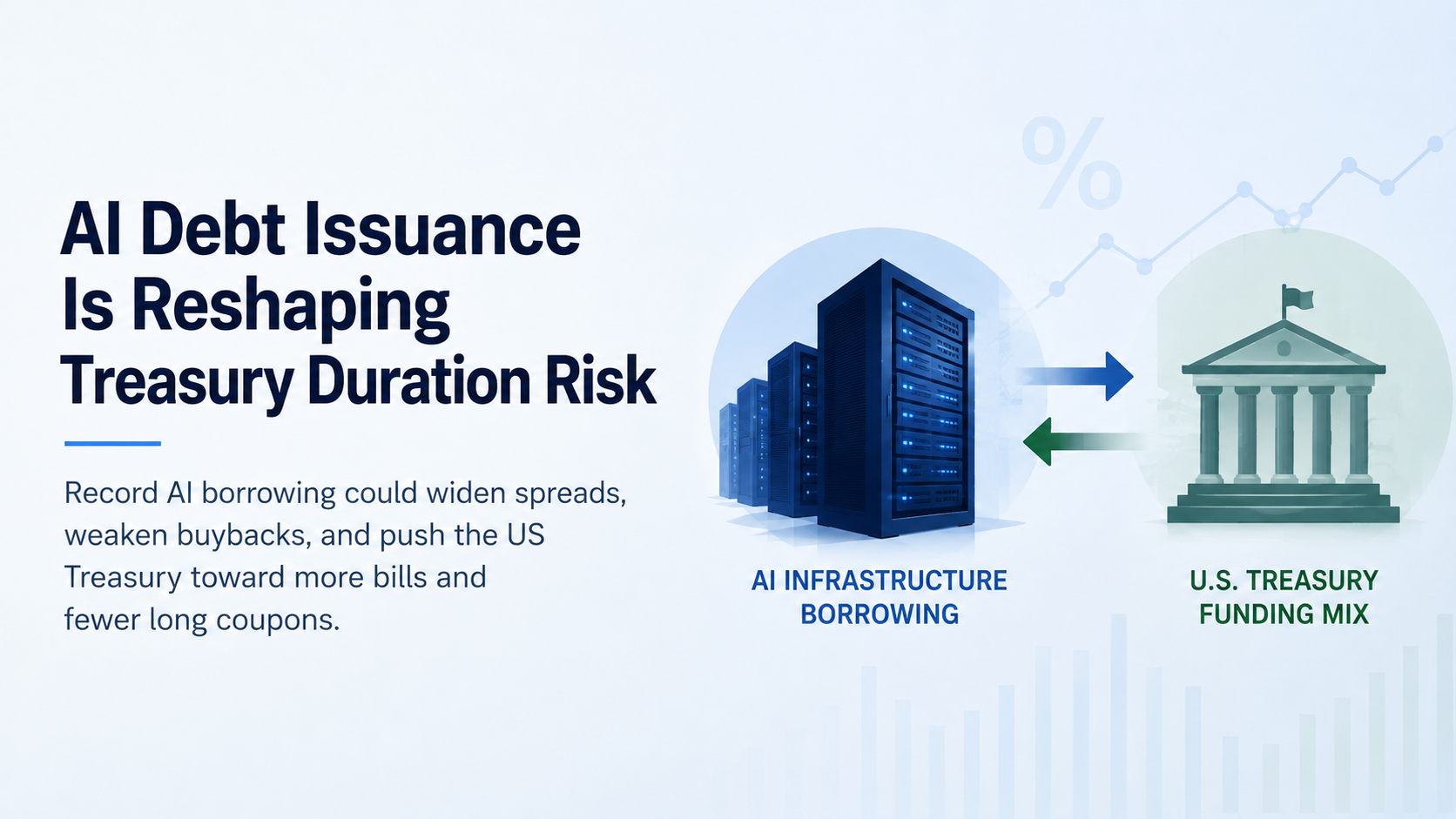
Macro Cross-Asset · AI Financing and Duration Supply
The AI investment cycle is no longer only an earnings and equipment-demand story. Its financing needs are becoming large enough to reshape credit spreads, equity flows and the market’s capacity to absorb long-duration assets.
The Funding Cycle Now Matters as Much as the Buildout
Fact
The report estimates that its hyperscaler and AI data-center cohort raised $269 billion through investment-grade bonds and loans in 2026 through the report date. That compares with an average of $23 billion per year from 2015 through 2024. On the report’s construction, the 2026 pace was nearly twelve times the earlier annual average, while overall corporate debt supply was running about 65% above the comparable prior-year period. (Source: Nomura Vol and Bloomberg, August 2026, PDF pp. 1-2)
Interpretation
This changes the investment question. The relevant issue is no longer simply whether AI spending creates enough demand for chips, power, construction and data-center equipment. Investors must also ask who finances that spending, what maturity the market receives, how much spread concession buyers demand and which existing sources of capital are displaced.
AI capex can therefore support nominal growth and selected industrial revenues while producing a less favorable outcome elsewhere: more corporate duration for fixed-income investors to absorb, less cash available for repurchases and greater sensitivity at the long end of the rates market. The spending impulse and the financing drag can coexist.
2026 year-to-date investment-grade bond and loan issuance for the report’s AI and hyperscaler cohort
Average annual funding shown for the same broad theme over 2015-2024, subject to scope differences
August 2026 OAS premium of the hyperscaler proxy over the broad investment-grade index
2026 buybacks minus issuance for the hyperscaler cohort in the report’s analysis
The headline multiple is a scale signal, not a clean growth rate. The report notes that the comparison combines bonds and loans and that the issuer universe changed over time. SpaceX enters through a June bond offering, while earlier loans unrelated to AI are excluded. The direction is meaningful, but “nearly twelve times” should not be treated as a perfectly standardized historical comparison.
High credit quality does not prevent supply-driven underperformance
Fact
In August 2026, the report’s hyperscaler credit proxy had an option-adjusted spread, or OAS, of 149 basis points, compared with 118 basis points for the broad investment-grade index. The resulting 31-basis-point premium had widened from 16 basis points in December 2024 and 24 basis points in June 2026. OAS is the extra yield over government bonds after adjusting for embedded options. (Source: Nomura Vol and Bloomberg, August 2026, PDF p. 3)
Interpretation
The key signal is not that hyperscalers suddenly became weak credits. It is that even financially strong issuers can underperform when a concentrated group repeatedly asks the same investor base to absorb large volumes of debt. Supply risk can appear before traditional default risk, and it can persist even when operating fundamentals remain sound.
A useful diagnostic is the relative spread rather than the absolute spread alone. If the hyperscaler premium keeps widening while the broader investment-grade index remains stable, the evidence would increasingly point to sector-specific saturation. If the premium compresses despite continued issuance, the market is demonstrating more absorption capacity than the thesis assumes.
The first equity consequence may be weaker demand for shares, not weaker earnings
The report shows the cohort’s next-twelve-month free-cash-flow projection falling sharply into 2026. At the same time, buybacks minus issuance moves from positive in every year shown from 2017 through 2025 to negative $147 billion in 2026. (Source: Nomura Vol and Bloomberg, August 2026, PDF p. 4)
Interpretation
This is a flow inflection rather than direct proof of an earnings contraction. A company can remain an AI revenue winner while becoming a less powerful buyer of its own stock. When capex rises faster than internally generated cash, management may redirect funds from repurchases, issue debt or do both. The resulting reduction in net equity demand matters disproportionately when the affected companies carry large index weights.
The hidden risk is therefore not limited to valuation compression from higher bond yields. Mega-cap equities could also lose a recurring mechanical bid at the same moment their financing programs add supply to credit markets. That creates two separate channels from the same investment cycle: a higher discount-rate burden and weaker corporate demand for shares.
Private AI borrowing may alter public debt maturity strategy
Fact
The rates analysis argues that Treasury buybacks and Federal Reserve System Open Market Account rollovers had kept the pace of 20- to 30-year auction duration supply relatively stable. A funding mix tilted toward Treasury bills had also kept annual net duration supply close to flat. Once AI and data-center borrowing in 2025 and 2026 is added, much of the duration previously removed by that bill-heavy approach reappears in private form. (Source: Nomura Rates, August 2026, PDF pp. 6-7)
Scenario
If this private issuance becomes structural and long-end buyers begin to demand larger concessions, the Treasury could respond by relying more on bills and limiting increases in long-dated coupon auctions. The initial market effect of heavy corporate borrowing may be bear steepening—long yields rising faster than short yields—but the eventual sovereign response could create a flattening surprise by reducing expected long-coupon supply.
The most important second-order implication: AI borrowers may not merely compete with other companies for capital. They may become large enough to influence where the US government chooses to issue along the maturity curve. This is a conditional reaction function, not an announced Treasury policy.
Gold and rates options can confirm whether the issue is becoming systemic
Gold had recovered roughly 10% from its mid-July close after declining about 27% from its late-January closing high. The report interprets the rebound as a potential release valve for concern that Treasury yields could become harder to control. Its CTA model had moved from a modest short position to a modest long, with the model reaching its maximum long signal above a then-calculated trigger of 5,056. (Source: Nomura QIS and Nomura Vol, August 2026, PDF p. 1)
The report also shows rising payer skew in swaptions and higher volatility-of-volatility at multi-year extremes. Payer swaptions protect against higher rates; richer payer skew therefore indicates stronger demand for insurance against an upside yield tail. Read together, gold strength, expensive protection against rising long rates and widening hyperscaler spreads provide a cross-asset test of the same funding-capacity concern.
None of these indicators proves causality on its own. Their value lies in confirmation. A credit-only move may reflect issuer supply. A simultaneous move in long-end options and gold would suggest that investors are beginning to price a broader problem involving fiscal capacity, term premium or confidence in rate control.
From Hyperscaler Credit to Gold: Where the Supply Shows Up
The evidence supports classification by transmission mechanism rather than a generic list of AI winners and losers. The labels below describe conditional exposure, not ratings or recommendations.
| Asset or exposure | Classification | Investment mechanism | Condition that must hold |
|---|---|---|---|
| Hyperscaler credit | Potential loser | Frequent issuance can force wider relative spreads even when default risk remains low. | Supply continues faster than dedicated investment-grade buyers expand capacity. |
| Mega-cap technology equities | Potential loser | Capex and financing needs reduce net repurchases, weakening a recurring source of equity demand. | The negative buyback-minus-issuance inflection persists rather than reversing quickly. |
| Long US Treasuries | Conditional beneficiary | A more bill-heavy sovereign funding mix would limit incremental supply of long-dated coupons. | Treasury places market absorption and long-end functioning ahead of expanding coupon sizes. |
| Gold | Conditional beneficiary | It may act as an alternative store of value when investors fear rising term premium or weaker yield control. | Macro anxiety remains dominant and systematic positioning does not reverse abruptly. |
| Long-end rates volatility | Watchlist | Higher payer skew and volatility-of-volatility reflect demand to hedge large upside moves in yields. | Duration supply and fiscal concerns keep the distribution of rates outcomes unusually wide. |
Issuance, Spreads and Refunding Guidance Will Show Whether Supply Bites
The thesis is measurable. Investors do not need to rely on a broad narrative about AI spending; they can track whether the financing channel is actually tightening market capacity.
| Indicator | Evidence supporting the thesis | Evidence weakening the thesis |
|---|---|---|
| AI bond and loan issuance | Borrowing remains elevated across multiple quarters and appears insensitive to financing costs. | Issuance falls materially because projects are delayed, reduced or funded internally. |
| Hyperscaler OAS premium | The premium widens while broad investment-grade spreads remain comparatively stable. | The premium compresses even as the cohort continues to issue at a high pace. |
| Buybacks minus issuance | Net flow remains negative, confirming that infrastructure spending is displacing repurchases. | Free cash flow rebounds and buybacks again exceed issuance. |
| Treasury refunding guidance | Official guidance favors a larger bill share or restrains growth in long-coupon auction sizes. | Financing needs lead to materially larger long-dated coupon supply despite private competition. |
| Gold and swaption payer skew | Both remain firm, indicating persistent demand for protection against a long-rate tail. | Gold positioning reverses and upside-rate insurance cheapens despite continued corporate issuance. |
A Front-Loaded Surge or Faster Cash Flow Would Ease the Pressure
- The issuance surge was front-loaded. This weakens the assumption that AI financing represents a durable new supply regime rather than a temporary wave concentrated in 2026.
- Investor capacity grows with supply. Dedicated demand from insurers, pension funds or credit investors could absorb new bonds without persistent spread concessions, weakening the crowding argument.
- The Treasury does not change its maturity mix. Federal financing requirements may dominate market-function concerns, leaving long-coupon auction sizes on a rising path and removing the proposed flattening response.
- Free cash flow recovers faster than the report projects. If hyperscalers can finance capex while restoring repurchases, the equity-flow channel becomes substantially less negative.
- Cross-asset signals have different causes. Gold, payer skew and credit spreads can move because of inflation, fiscal policy, general corporate supply or positioning. Their co-movement does not prove that AI debt is the common driver.
The largest analytical limitation is causality. The report identifies a coherent sequence across corporate issuance, credit spreads, buyback flows, Treasury duration and hedging markets, but several macro forces operate at the same time. The investment case is strongest when the indicators move together and weakest when only one market confirms it.
The report changes the AI investment framework from a one-sided growth story into a two-sided capital-allocation problem. Infrastructure spending can support activity and selected corporate revenues, while its financing simultaneously adds duration, pressures relative credit spreads and reduces the cash available for share repurchases.
The central mechanism holds only if AI borrowing remains structural and markets require greater compensation to absorb it. The most consequential implication is a possible Treasury shift toward bills and away from additional long coupons; the clearest thesis-breaking risk is that private investors absorb the supply smoothly while hyperscaler free cash flow and buybacks recover.
Leave a Reply